
Apollo Dental Health Clinic
Crown Restorations
A crown is a restoration placed over the natural tooth to restore its natural shape and/or appearance while at the same time restoring its strength and function.
Book Online
A crown is a restoration placed over the natural tooth to restore its natural shape and/or appearance while at the same time restoring its strength and function.
Book Online
Your dentist has identified that your tooth is weak, perhaps because it is heavily filled and/or broken, or that you have an existing crown restoration which is failing. He/she has taken all factors into consideration regarding the best possible treatment and has advised a crown to restore the tooth in an attempt to preserve it for the longterm.

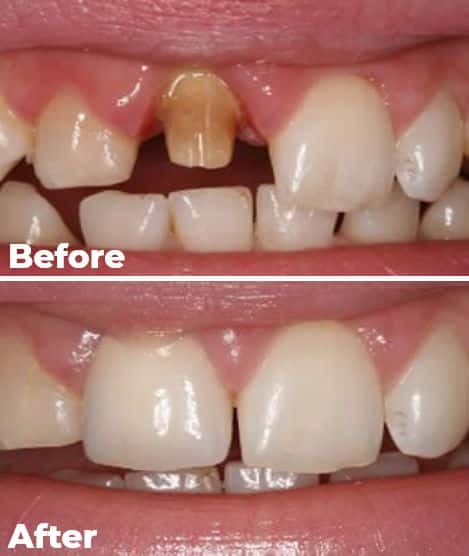
Your tooth will be prepared, usually under local anaesthetic, to a specific shape which will allow the crown to fit over it without making the tooth too bulky. Impressions will be taken of both the upper and lower jaws so the technician can make the crown on a complete set of models of your teeth. This will allow the technician to shape the crown correctly so that it matches the rest of your teeth and functions properly.

There are several types of crown available, each with its own advantages, disadvantages, and cost. Generally speaking, a crown can be either:
A crown restoration will typically need two appointments. The first appointment will be for preparation of the tooth and impression taking. This appointment will be about an hour long. You will usually have a temporary crown fitted to the tooth to keep it protected and functioning for the 2-3 weeks before your second appointment. The second visit will usually be for 20 minutes. At this appointment, your dentist will remove the temporary crown and check the new permanent crown for correct fit, appearance, and function. The permanent crown is cemented to your tooth and you will be given appropriate advice on maintenance.
Sometimes a tooth may be very broken down and require additional support for the crown in the form of a post. If your tooth requires a post to help support the final crown, you may need additional appointments for the making and fitting of the post.
The crown is cemented to the prepared tooth using a special cement which bonds the crown to the tooth. This cement is strong enough to allow you to use the tooth for normal chewing.
Your dentist will discuss with you the best options for your tooth, but you will have the final say on what you want, having weighed up all considerations.
If you have opted to have a ceramic crown, your dentist will match the crown to the adjacent natural teeth as closely as is possible. When dealing with a front tooth, it may be impossible to match the colour of the crown to the adjacent natural teeth exactly. This is because porcelain is a different material to natural enamel, with different light-reflecting properties. Modern dental ceramics, however, have made colour matching much more predictable, and the crown should not be obvious when fitted. In addition to this, we often use digital photography to aid in relaying important information about the shape, colour, and position of the teeth to the technician. Sometimes we even arrange for the patient to visit the technician’s laboratory so that he can see the adjacent natural teeth and mimic them for optimal results.
If your tooth is broken, or has a large restoration that is failing, you could opt to have it restored with a large filling. This will restore the tooth for the immediate future. However, large fillings weaken the natural tooth structure, with increased risk of fracture, making restoration of the tooth more difficult later.
A crown procedure is not a painful process. Local anaesthetic will be used to numb the tooth when it is being prepared for the crown and again when the crown is being fitted. Some patients reports a mild sensitivity in the tooth after the preparation appointment, while the temporary crown is in place.
A crown is an extensive restoration for a tooth, but often necessary to preserve its strength. As with all extensive restorations, there is a risk that the nerve in the tooth will eventually die, sometimes many years after crown placement. It is estimated that 12% off all crowned teeth will eventually feature nerve death leading to the need for either root canal therapy or extraction.
No dental restoration lasts for ever. Any restoration is a compromise to natural healthy tooth structure. A crown restoration will typically last 10 – 15 years, provided it is looked after by you, the patient, in terms of cleaning and avoiding high risk factors for dental disease. If and when the crown fails, a new crown can usually be fitted to keep the tooth restored.
Finance makes a wide range of treatments more accessible by spreading the cost. Whether you’re facing an unexpected treatment, are in need of exceptional dental care or want to improve the appearance of your teeth, don’t let the cost of treatment get in the way of your smile. We have several finance options available – talk to us to find out how we can help you spread the cost of your treatment.

We are open on Saturdays and for late evening appointments until 9pm on Tuesdays, Wednesdays and Thursdays


"*" indicates required fields